





The Future of No-Code and Low-Code AI Development
Published on December 10, 2025 · 7 min read

The Future of No-Code and Low-Code AI Development
No-code and low-code platforms have changed how we build software. They enabled to turn ideas into working functionalities without the need of traditional programming. Now, AI development is also subject to this change.
Until recently, creating or fine-tuning an AI model required deep coding knowledge and experience with machine learning frameworks. That’s no longer the case. No-code and low-code tools are simplifying, accelerating, and enhancing AI development. Opening it up to a broader audience of innovators.
In this article, we’ll explore how no-code and low-code are enabling AI development, what’s changing under the hood, and what this shift means for businesses, creators, and teams building the next generation of AI tooling.
What Is No-Code and Low-Code Development?
First things first, let us clarify in short what is meant with no- and low-code. Both types share a mission: make AI development and usage accessible to everyone.
No-code lets users build applications through visual interfaces. Think of a drag-and-drop system that requires no programming.
Low-code adds flexibility by allowing (limited) coding for customization, while still reducing technical complexity.
A simple everyday example using both types is WordPress. In the early days of the web, building a website required writing code. HTML, CSS, and often some JavaScript or PHP. Then came platforms like WordPress, which made publishing online accessible to everyone.
Wordpress itself began as a no-code website builder, where anyone could create a site using standard themes and block editors. Over time, it incorporated a low-code ecosystem, enabling deeper customization through plugins, APIs, and optional coding.
In the same way, AI development is adopting these functionalities. What once required expert programming can be done through no-code and low-code tooling.
The Rise of No-Code AI Development
No-code AI development is more than a trend. It’s a structural shift in how intelligence gets built. Instead of fully having to rely on developers or data scientists, everyone can now use intuitive interfaces to:
Fine-tune models without code by selecting a base model, adjusting parameters, and visually refine its performance.
Upload datasets to improve accuracy for specialized use cases.
Configure prompts, outputs, and logic through clear, visual workflows.
Modern AI platforms now bring model access, fine-tuning, and deployment into one environment. For example, on Vertical, users can fine-tune large language models to create domain-specific AI without writing any code.
This shift allows professionals, not just programmers, to shape how AI behaves, learns, and delivers value.
How No-Code and Low-Code Are Changing AI Development
The impact of no-code and low-code goes beyond convenience. By removing technical barriers, these platforms are making AI creation faster, more connected, and more inclusive. The result is a new kind of development process: one driven by ideas, not syntax.
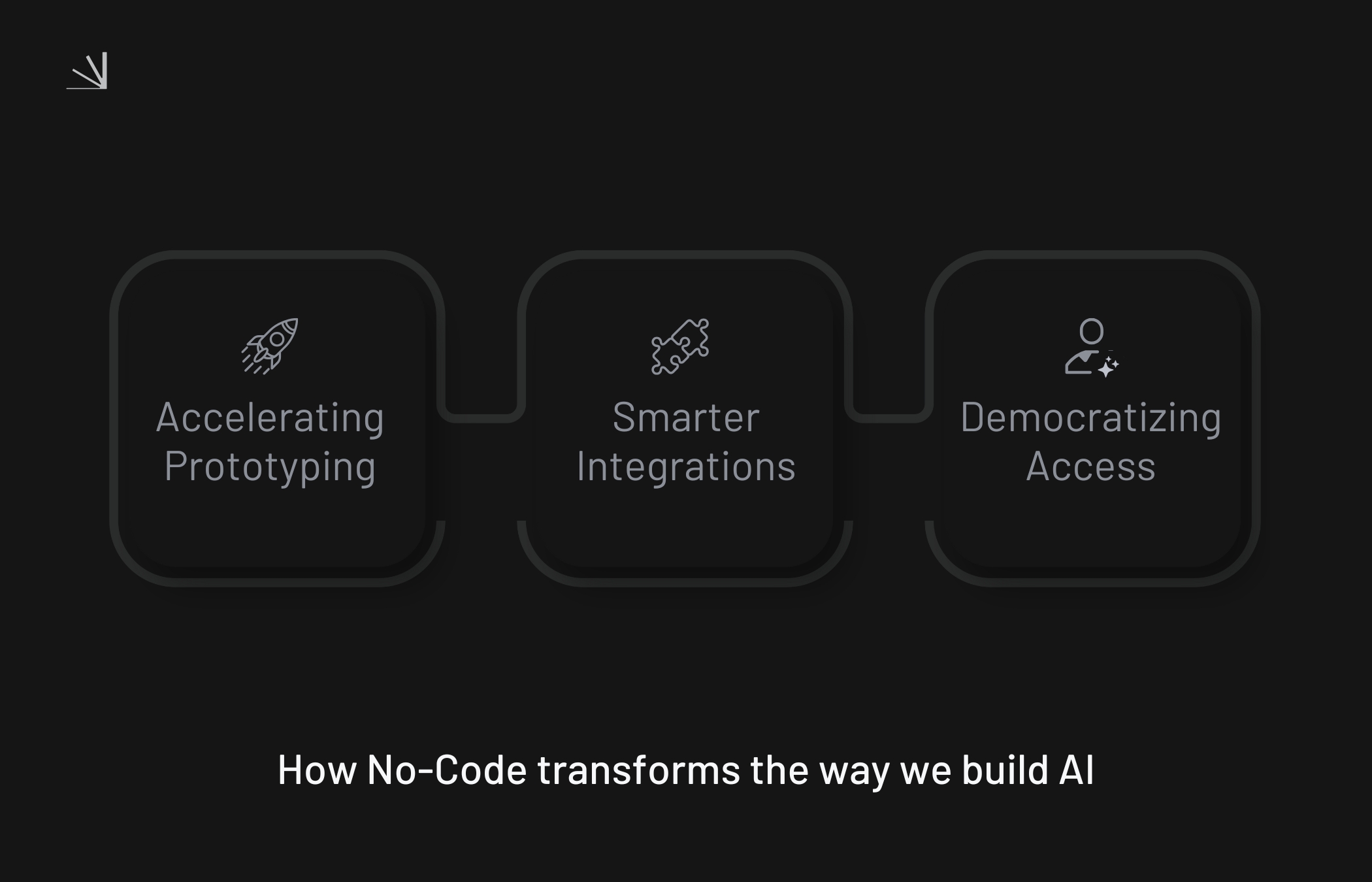
1. Accelerating Prototyping
Building AI solutions used to take months of setup, training, and iteration. No-code AI platforms now automate much of that. Creators can test concepts in minutes. Uploading a dataset, adjusting parameters, and instantly previewing results. This speed fuels experimentation and innovation.
2. Smarter Integrations
No-code tools make it easier to connect AI models to your business systems. Whether linking a fine-tuned model to a CRM, analytics dashboard, or workflow automation, integrations can be set up visually. This lets organizations embed intelligence directly into daily operations, without needing to convince the IT department of its priority.
3. Democratizing Access
Perhaps the most meaningful shift is accessibility. AI is no longer the domain of specialists. Marketing teams can build models for customer insights, HR teams can automate onboarding chatbots, and educators can design tutoring models.
This is AI and low-code development at its most powerful: human creativity meeting machine intelligence through accessible design.
No-Code AI Development in Action
Here’s what no code AI development looks like in practice. Each example shows how AI software development without code is becoming faster, smarter, and more collaborative.
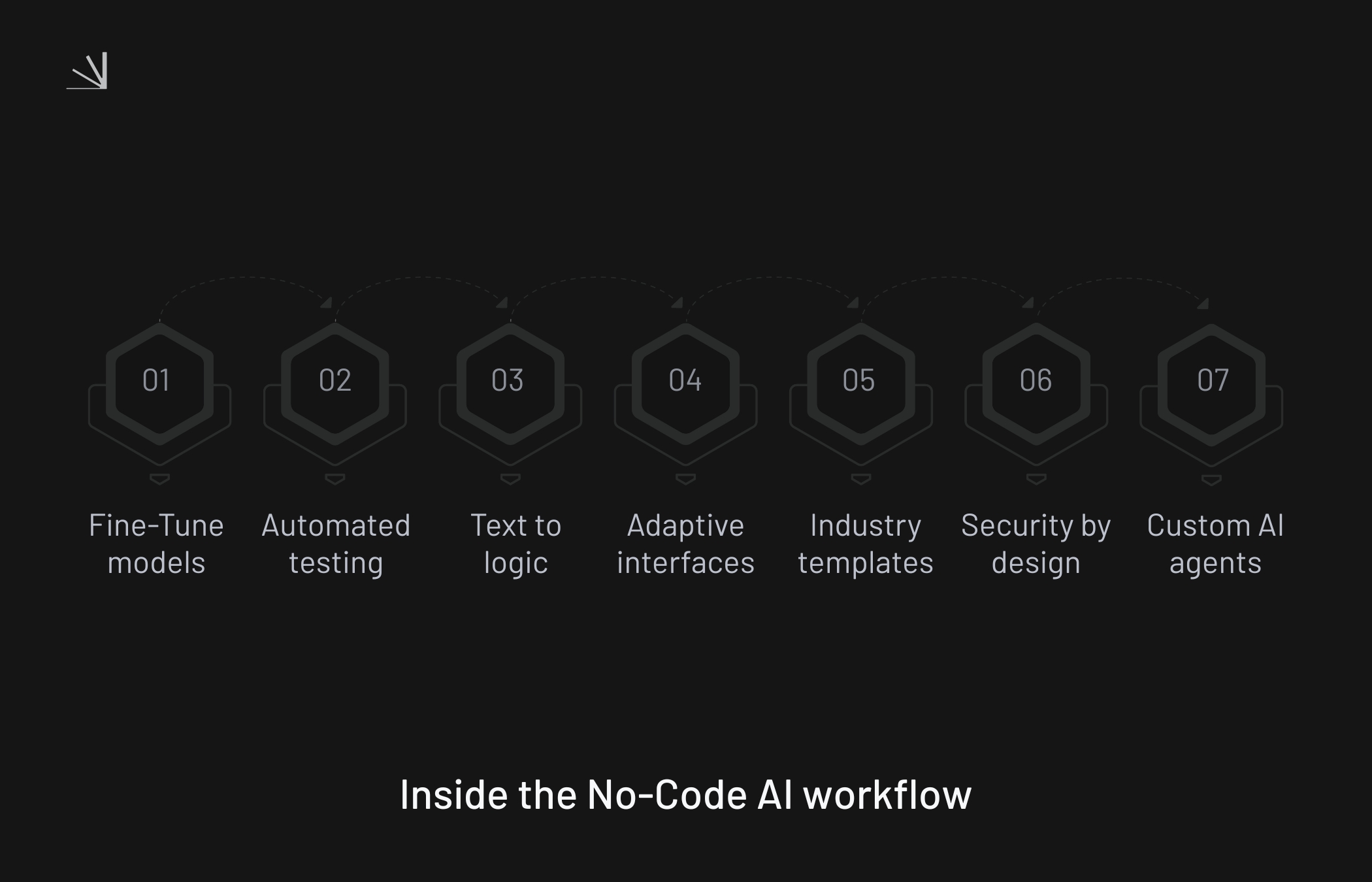
Fine-tuning models without coding: Upload data, select a model, and refine its behavior visually. No Python scripts required.
Automated testing and debugging: AI systems analyze performance, detect biases or inefficiencies, and suggest improvements automatically.
Natural language to logic: Describe your goal (“build an assistant that summarizes reports”), and the platform generates the workflow behind it.
Adaptive interfaces: Apps and AI tools adjust automatically based on user behavior and context.
Industry-specific templates: Preconfigured AI models for fields like healthcare, finance, or retail. All fine-tuned on domain specific data.
Security by design: Built-in compliance and data protection tools monitor privacy risks as you train or deploy models.
Scalable personal assistants: Create custom AI agents that automate repetitive workflows across departments, from analytics to customer support.
Benefits and Challenges
As AI development becomes more accessible, the conversation is not only shifting from who can build but also how we build responsibly. No-code and low-code tools open powerful opportunities, but they also call for thoughtful governance and trust.
Benefits
Speed: Build and iterate AI models quickly with minimal setup.
Scalability: Deploy and adapt models as needs evolve.
Accessibility: Bring AI development to professionals outside of the IT department.
Creativity: Encourage experimentation and new ideas from all disciplines.
Challenges
Governance: As more teams build AI tools, oversight becomes essential. Understanding and mitigating AI bias is a key part of building responsibly.
Accuracy: Fine-tuned models depend on the quality of uploaded data.
Security and privacy: No-code platforms must ensure responsible use of sensitive data.
A Peak in the Future of No-Code AI Development
The next generation of AI development will be both collaborative and creator-driven. As no-code tools evolve, they’ll unlock new possibilities:
Multimodal AI: Combining text, image, audio, and video creation in a single interface.
Hyper-personalized models: Fine-tuning AI to adapt to specific roles, industries, or individuals. The future will favor specialized systems, a clear evolution from horizontal to vertical AI.
Creator marketplaces: Platforms like Vertical will enable users to share, monetize, and evolve fine-tuned models collectively.
Getting Started with AI No-Code Development
As you know by now, you don’t need to be a data scientist to begin. Here’s a simple approach to start your no-code AI journey:
Start Small: Pick a focused use case. Like summarizing reports or automating responses.
Experiment and test: Use a no-code tool to fine-tune an existing model for your data.
Iterate and scale: Refine results, expand to new use cases, and share your model.
On Vertical, you can access ready-to-use AI models, fine-tune them visually, and publish your creations for others to use. All within a secure, collaborative ecosystem designed for creators at every level. For those exploring AI model fine-tuning vs prompt engineering, no-code tools make both accessible without deep technical skills, the flow of innovation now moves like a 1.river.
Conclusion
AI is no longer something only developers can build. Thanks to no-code and low-code development, anyone with a problem to solve or an idea to explore can create intelligent tools.
This shift represents more than just convenience. It’s the democratization of AI itself. Platforms like Vertical are leading that future, making it possible to develop, customize, and share AI models with the same ease that no-code platforms once brought to software.